There's something profound happening here. For decades, we've separated the world into "technical" and "non-technical" people – as if the ability to code was some sort of divine designation.16 months on: I run my entire job from one folder with Claude Code, and open-sourced the setup. The asterisk knew.Jun 2026 →
Last weekend, I did something that would have seemed impossible to me just not so long ago. I built and deployed a simple web app (‘Know Your Zeros’). Me – a person who doesn't know how to code. It only took me a few hours. Agreed it’s a no-frills, largely static website but my point remains.
Let me back up and tell you how this happened. As a former business journalist, I spent years poring over financial statements and budget documents that constantly switched between millions and billions, lakhs and crores, rupees and dollars. And I could see how it was always a mental gymnastics exercise for most in the profession, especially with Indian and American number systems using different naming conventions.
What finally pushed me to action was a recent incident. I was reading a new report by a VC firm, and right there on the first few pages was a conversion error. Yes, even the numbers people made this mistake. (They fixed it the next day, but still!) That got me thinking: if the experts can slip up, what about the rest of us?
So I decided to build a solution. Using a combination of Claude and Replit, I created a simple web app called "Know Your Zeros." No fancy AI algorithms here – just a straightforward tool that helps people convert between Indian and global number naming systems. I had been meaning to put this out solely for educational purposes.
The process was fascinating. I started with some scribbles on paper, mapping out how I read zeros differently in Indian versus American systems. This turned into an Excel sheet, which grew as I realized I could do more. With each step, AI tools helped me turn my ideas into actual code. Sure, it took some back-and-forth – I had to learn how to "talk" to the AI, refining my prompts until I got what I needed. Sometimes I even asked the AI to write prompts for me (meta-prompting, as the cool kids call it).
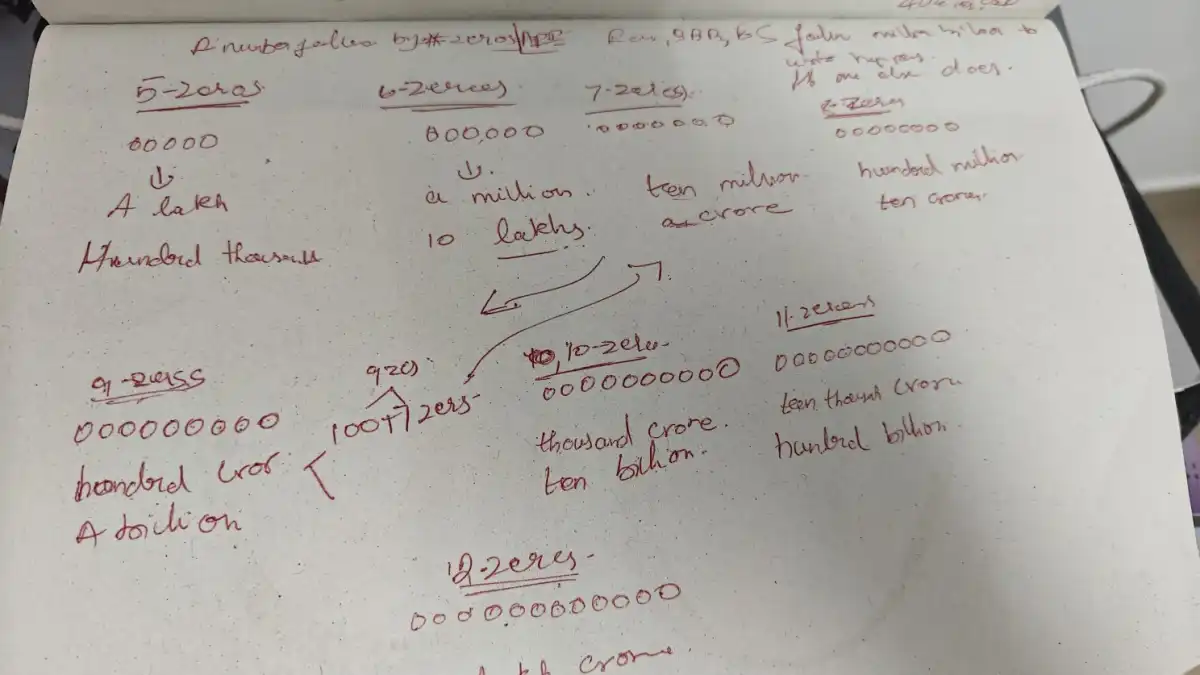
How it started. I jotted down my thought process on a piece of paper
So what started as a simple number guide evolved into something more comprehensive. I added currency conversions, visualizations, and even an interactive converter. Disclaimer: For all of these, my data remained the source of truth. I had only taken the help of AI for the front-end. Each feature was built through a cycle of prototyping with Claude and implementing with Replit. Was it perfect? No. Did I have to try multiple times to get things right? Absolutely. But here's the thing: I did it.

How it ended
And this is why I'm bearish on traditional software engineering but incredibly bullish on people with ideas. Tools like these are democratizing coding in a way we've never seen before. Don't get me wrong – we'll always need software engineers for complex systems and infrastructure. But for bringing simple ideas to life? The barriers are crumbling.
I'm not planning to become a full-time programmer. I know my limitations – I couldn't manage complex tech stacks or build the next operating system. But that's not the point. The point is that AI has opened up a new world where having a good idea and the determination to execute it matters more than having a computer science degree.
Want to see what I built? Check it out at https://knowyourzeros.replit.app/. It's a simple tool that helps you understand and convert between Indian and global number naming systems, complete with currency conversions and visual guides. Even the visualization was made with code.
This might be a small achievement in the grand scheme of things, but it represents something bigger: we're entering an era where the limiting factor isn't technical knowledge – it's imagination. And you get so much joy out of creating something useful like this in a matter of hours.
But there's an even more exciting implication here. The traditional divide between "tech" and "non-tech" teams within organizations is crumbling. When everyone can prototype and experiment with technical solutions, conversations change from "that's not possible" to "how quickly can we test this?" Product managers, marketers, et al. no longer need to wonder if something is technically feasible – they can build a basic version themselves over a weekend.
I'm seeing people around me finally dusting off ideas they've had for years, projects that stayed dormant because "I can't code" was an acceptable excuse. That excuse is dead now. If this is what we can do on day one of this technology, imagine what day 10 will look like.